
On September 26, the 2025 Low-Altitude Economy Forum & International Conference on Low-Altitude Flight Technologies and UAV Applications (LEF & ICLU 2025) was successfully held online.

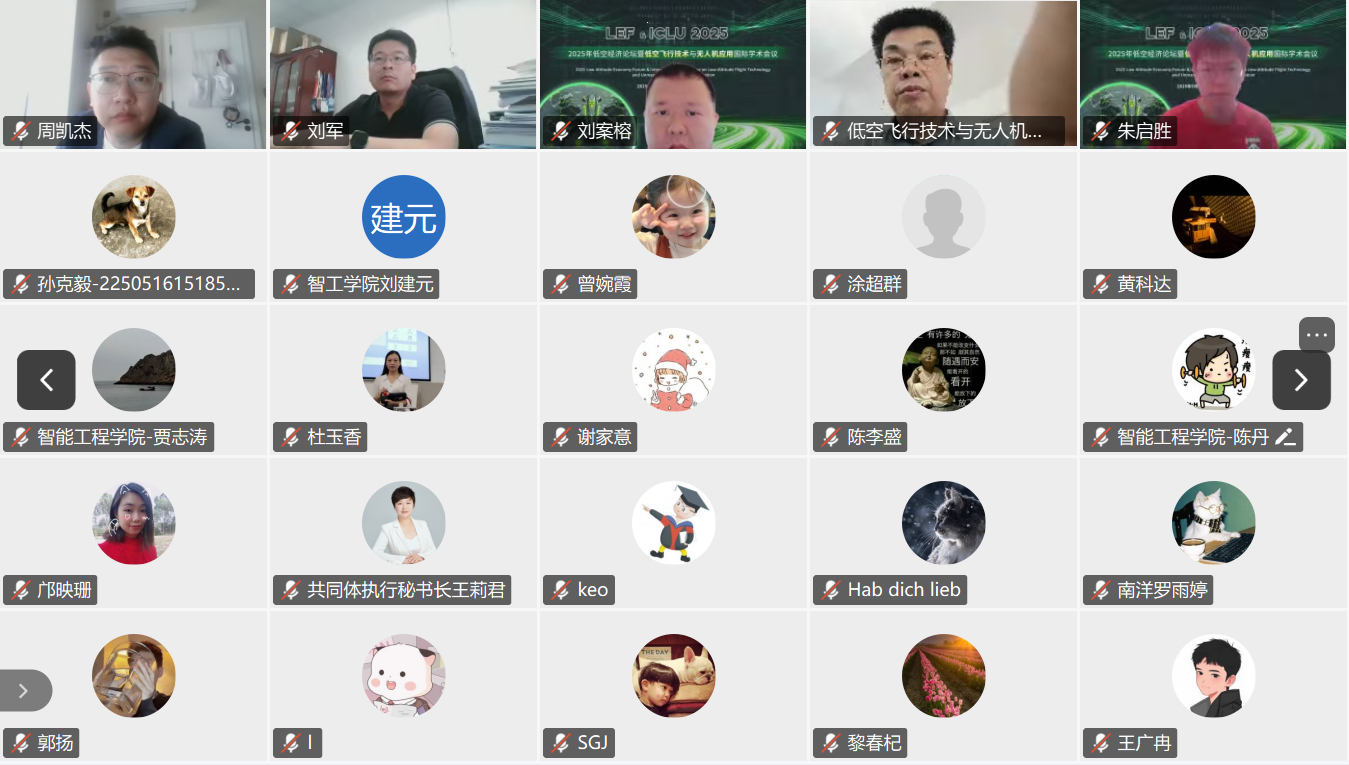
The conference was jointly guided by the Greater Bay Area Industry-Education Alliance, the National Intelligent Aircraft Industry-Education Integration Community, and the Guangdong Digital Economy Industry Innovative Talents Alliance (in preparation). It was co-hosted by Guangzhou Nanyang Polytechnic College and Guangdong University of Science and Technology. The joint organizers included the School of Intelligent Engineering at Guangzhou Nanyang Polytechnic College, the Greater Bay Area Industry-Education Research Institute, the Dongguan Social Science Expert Digital Economy Studio, the Humen Digital Economy Industrial College, and Guangdong Bossiyun Science and Education Technology Co., Ltd. Strong support was also provided by the Shenzhen UAV Industry Association, the University of Science and Technology Liaoning, Guangzhou Huake Technology Co., Ltd., and other organizations. More than 200 experts, scholars, and representatives from domestic universities, research institutions, and leading enterprises gathered online for the event.
The conference was moderated by Professor Yue Liu, Dean of the School of Intelligent Engineering at Guangzhou Nanyang Polytechnic College.

In his welcome address, Professor Baiqing Li, Executive Vice President of Guangzhou Nanyang Polytechnic College and representative of the host institutions, pointed out that the low-altitude economy, as an emerging industry, urgently requires the deep integration of academic research and industrial practice. He stated that this conference was precisely established to promote this integration, and he looked forward to injecting new vitality into low-altitude technological breakthroughs and industrial development through the wisdom shared by experts in the field.

Professor Biaoxin Chen, Chairman of the Greater Bay Area Industry-Education Alliance, Executive Chairman of the National Intelligent Aircraft Industry-Education Integration Community, Chairman of the Guangdong Digital Economy Industry Innovative Talents Alliance, and Vice President of Guangdong University of Science and Technology, stated in his address that the low-altitude economy, as a nationally strategic emerging industry, is reshaping the development landscape of transportation, logistics, emergency response, agriculture, and many other fields at an unprecedented speed. Against the backdrop of rapid industry development, industry-education integration, and cross-border collaboration, this conference is both timely and profoundly significant. As guiding bodies for this conference, the Greater Bay Area Industry-Education Alliance and the National Intelligent Aircraft Industry-Education Integration Community will continue to act as bridges and links, supporting member units in carrying out practical cooperation in standard setting, technological breakthroughs, talent cultivation, and achievement transformation, collectively building an open, collaborative, and win-win ecosystem for the low-altitude economy.

During the keynote speech session, four experts delivered presentations combining academic depth and practical value, focusing on key directions in low-altitude flight technologies and UAV applications.
Professor Hongming Chen, a Foreign Academician of the Russian Academy of Engineering, a Corresponding Academician of the National Academy of Artificial Intelligence (USA), and a professor at Zhejiang Ocean University, presented on "Collaborative Technologies and Application Scenarios of Dual-Unmanned Systems." Drawing on his long-term research in IoT technology and chip design, he deeply analyzed the technical challenges and application scenarios of dual-unmanned system collaboration, offering new ideas for multi-device collaborative operation in the low-altitude domain.

Professor Jun Liu, a National High-Level Overseas Talent, a Guangdong Pearl River Talent, Director of the Guangdong Provincial Key Laboratory of Advanced Energy Storage Materials, Director of the Advanced Energy Storage Technology Innovation R&D Center at the China-Singapore International Joint Research Institute, and a professor at South China University of Technology, focused on "Research on Key Materials and Interfaces of Polymer-Based Solid-State Batteries." Leveraging his team's academic output of over 200 papers (including 25 ESI Highly Cited Papers) with more than 16,000 citations, he shared innovative breakthroughs in solid-state batteries for UAV energy supply, providing technical solutions to address the endurance challenges of low-altitude equipment.

Professor Baoquan Li, an IEEE Senior Member, a Tianjin "131" Innovative Talent, a Young and Middle-Aged Backbone Innovative Talent in Tianjin universities, and a professor at Tiangong University, presented on "Environment Perception and Motion Planning for Rotary-Wing UAVs." Combining his research background in mobile robotics and computer vision, he elaborated on perception technologies and path planning strategies for UAVs in complex environments, offering significant reference value for improving UAV operational safety.

Associate Professor Kaijie Zhou from Huaiyin Normal University delivered a keynote report titled "Lightweight and Efficient Hybrid UAV Identification Network Based on Radio Frequency Fingerprints." His research achievements in the field of signal perception and processing provided new methods for precise UAV identification and control.

Following the keynote speeches, five representatives of outstanding paper authors from enterprises, universities, and international institutions—Meng Xu from Qingdao Kongyuan Intelligent Technology Co., Ltd., Yizhou Yan from the China Aeronautical Radio Electronics Research Institute, Lufan Li from Northwestern Polytechnical University, Ziheng Xu from Nanjing University of Aeronautics and Astronautics, and Elham Fakhraian from Ghent University, Belgium—delivered oral presentations covering specialized areas such as low-altitude safety, airspace efficiency, fault diagnosis, and path planning. The interactive Q&A sessions after each presentation saw active participation from online guests, fostering a strong atmosphere of academic exchange.
This LEF & ICLU 2025 international academic conference fully embodied the concepts of "industry-education integration and cross-border collaboration," featuring excellent expert exchanges, sharing of scientific and technological achievements, and a collision of ideas. It aims to build a high-end communication platform for academic research, technological breakthroughs, and industrial applications in the low-altitude economy field. The conference will serve as a bridge, working together to build an open, collaborative, and win-win ecosystem for the low-altitude economy, helping to establish the Guangdong-Hong Kong-Macao Greater Bay Area as a hub for low-altitude economy innovation.